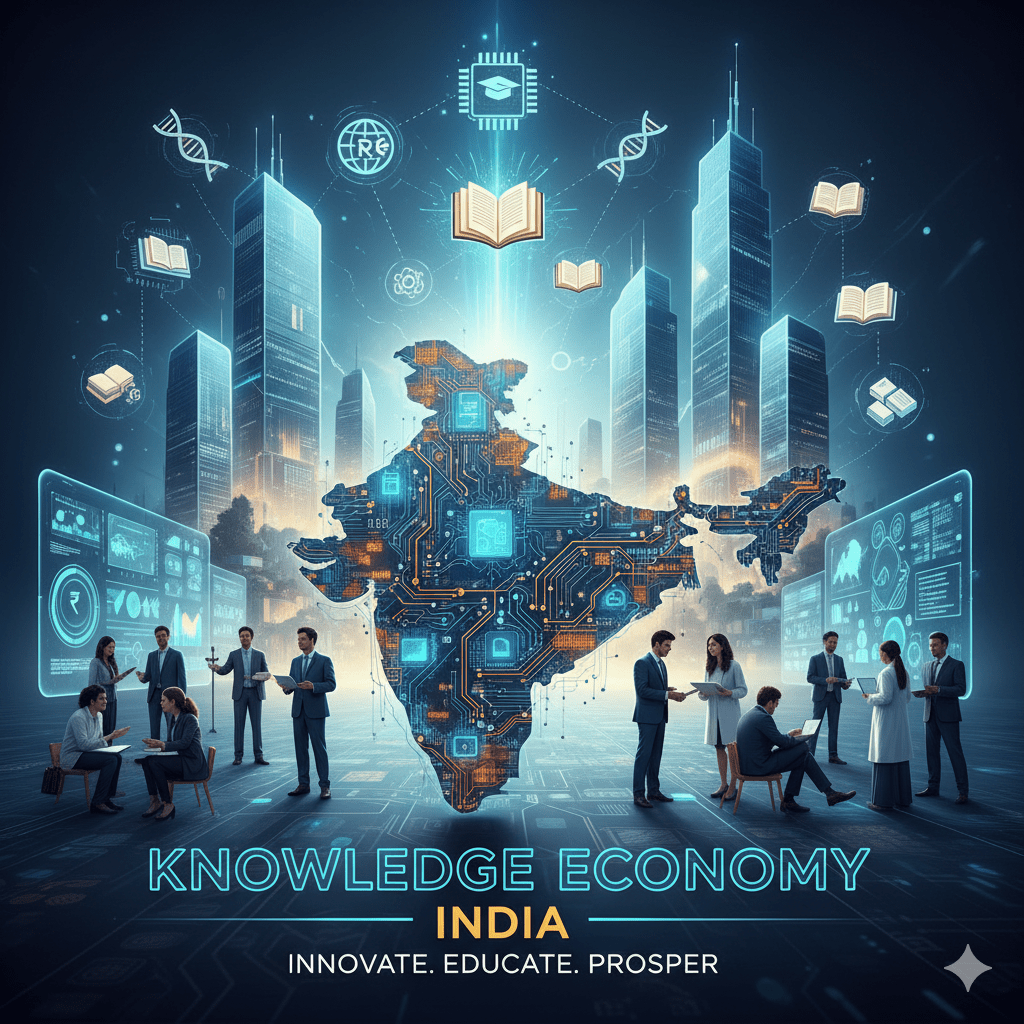
GDP to GDKP, the transition getting millions and millions of young talents onboard the Knowledge Economic Development of India.
India’s Knowledge Economy
Knowledge economy develops a framework to yield the best return on knowledge investment for elevating its impacts on economic and social life in the country.
Ministry of Statistics and Programme Implementation describes that Knowledge plays a very critical role in economic development, measurement of domestic knowledge items would provide us with insights into the knowledge structure of an economy, which in turn would help define knowledge policy to steer national economic development to solve the varied socio-economic problems facing the nation. Moreover, India is currently evolving strategies to capitalize on its demographic dividend to make it a developed economy by 2047. Knowledge will play a critical catalytic role in this transition. Thus, quantification of the contribution of these knowledge items/products in the national GDP assumes vital significance.
The Gross Domestic Product of a nation measures the total output of goods and services, the impact of Knowledge creation and its dissemination in economic growth does not get effectively captured as GDP metric is not conceptualized to provide that information. GDP was intended to measure economic activity and thus facets of knowledge embedded in the activities are not given its due prominence (Source: https://www.mospi.gov.in/concept-note )
The World Bank Approach
The World Bank measures knowledge-related economic indicators through metrics like the Knowledge Index to supplement the GDP. GDKP is an alternative measure of a nation’s wealth, focused on knowledge creation rather than traditional goods and services. An economic indicator prepared by the World Bank Institute is to measure a country’s ability to generate, adopt, and diffuse knowledge.
India’s Talent Powerhouse
India’s share in the global talent pool is growing year by year. India’s strength of higher education students in STEM fields contribute in a great way to make the country becoming a hub for digital talent and R&D. However, India’s overall ranking in the Global Talent Competitiveness Index (GTCI) is lower than some developed nations. Migrated Indian S&T Diaspora talent pool take active role in the knowledge based economic programs of developed economies.
Minister of External Affairs Dr Jaishankar said that there is greater interest in the growth of Global Capability Centres (GCCs) in India that take the quality of economic activity to a much higher level (https://www.mea.gov.in/Speeches-Statements.htm?dtl/39466/EAMs_remarks_at_the_launch_of_Global_Access_to_Talent_from_India_New_Delhi_May_06_2025 )
Brain Circulation for Knowledge Transfer
There are currently roughly about 34 million Indians and PIOs living and working abroad. While Developed Economies engage Indian talents for enhancing knowledge based economic development through innovations for the advanced technologies and products, one third of diaspora population is located in the Gulf region housing domestic services, infrastructure development and fossil fuel economic growth, not commonly known for knowledge intensive economic development activities.
Global Diaspora cited as India’s enviable ingredient needs greater push for Brain Circulatory Knowledge Networks to get them connected with the home needs and place them back in the home talent pool through the reverse migration.
Domain specific Knowledge Management Networks connecting Global Indian Diaspora are yet to occupy a space in New World Order. Migration through knowledge path is subjected for severe turbulence in the present world. The reverse migration path needs to be a smooth one protecting the knowledge strengths of Indian diaspora.
Innovation & Entrepreneurship aspirations of the young talents at the school level Atal Tinkering Lab ecosystem will elevate the present innovation networth to attain a convincing knowledge health level in future curtailing the talent flow out of the country.
 முப்பரிமாணம் (Mupparimanam) - 3D development for connecting the ancient and modern thinking with UN SDGs Sustainable Development Goals. 3D thinking on Tamil Literature and Traditional Practices, the source of Global Goals.
Leave a comment