
Migration for Academic Knowledge Acquisition
Migration Data Portal reported that The numbers of internationally mobile students are increasing and destinations diversifying. In 2022, there were an estimated 6.9 million international students globally, a 176 per cent increase over the past two decades, from 2.5 million in 2002.
More than one third (38% or 3 million) of the 6.9 million international students originated from ten countries. Share from China (1,052,000), India (622,000), Uzbekistan (150,000), Viet Nam (134,000), Germany (126,000) and The United States of America (115,000) is notable.
Indian Students in the Overseas
According to data from the Ministry of External Affairs in response to Rajya Sabha QUESTION NO. 2313 INDIAN STUDENTS PURSUING HIGHER EDUCATION ABROAD, the number of Indian students going abroad for studies has steadily increased over the years with a slight dip in 2024.
2022 – 7,52,111
2023 – 8,94,783
2024 – 7,60,073 (Source: Ministry of External Affairs)
Academic Knowledge Acquisition
A research study on “Top Talent, Elite Colleges, and Migration: Evidence from the Indian Institutes of Technology” documented that the incidence of migration among top talent is sizeable. This study results suggest that elite schools play a key role in shaping migration outcomes, both in terms of the overall propensity and the particular migration destination. Among the top 10 scorers, nine have migrated. Among the top 100 scorers, 62% have migrated, and 36% among the top 1000 (Source: Journal of Development Economics Vol. 164, Sept 2023, 103120).
Affordability
It is not an easy finance mechanism for all students. Many students who come from the middle class segment look for financial support through scholarships, teaching/research assistantship, bursaries and loans to fulfill their aspirations for academic knowledge acquisition outside India.
Tighter immigration policies and increase in the living cost for international students in the overseas put more financial responsibilities on the shoulders of parents. Cost of overseas education is increasing year by year due to the rising cost of accommodation and local living expenses.
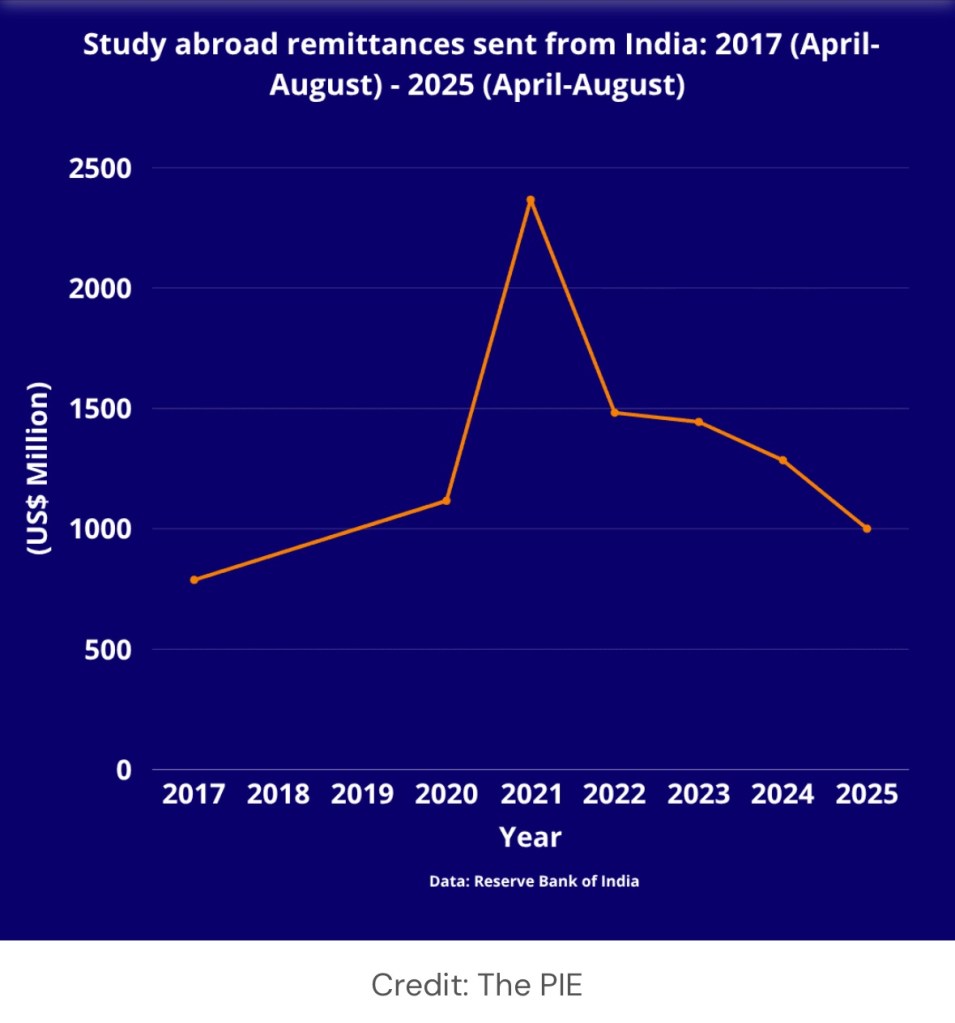
The PIE reported that Study abroad remittances from India at lowest level in eight years. As per RBI data analysed by The PIE, study abroad remittances from India fell by US $1.37 billion (nearly 58%) between April and August 2021 and the same period in 2025, signalling a steep drop from the post-pandemic peak.
While Indian students’ growing preference for emerging study destinations – including Asian countries like Japan and South Korea, European nations such as Germany, France, Ireland, Italy, and Finland, and Middle Eastern and Central Asian destinations – especially for undergraduate and medical studies, has possibly contributed to lower spending on studying abroad compared to previous years, an increasing number of students are also availing education loans in the country, helping them manage potential extra costs.
In May 2025, the UK government’s immigration white paper included an intention to explore introducing “a levy on higher education provider income from international students”, which would be reinvested into the higher education and skills system. The white paper said further details would be set out in the 2025 Autumn Budget.
Recent announcement from Australia
Interesting to see the emphasis on elevating Government priorities for partnerships with the regional countries through the International education offered by the native higher education institutions. Cost of living for the international students is increasing year by year. Government interventions in such areas will give financial comforts to the international students who migrate for knowledge aspirations with the self supporting financial resources.
Overseas Employment
Financial Express reported that Indian Students seeking international studies and careers are navigating a rapidly evolving educational landscape. Several countries have introduced new reforms impacting their immigration and student visa policies.
It is not an easy task for the Indian students to find an employment immediately after the completion of their academic courses. ICEF Monitor described this scenario as changes in the immigration policies and employment opportunities hosted by Big 4 countries. Just a couple of years ago, Indian students were flocking to a number of attractive study abroad destinations, and especially to the “Big Four” of Australia, Canada, the United Kingdom, and the United States. Collectively, those four host countries welcomed more than 70% of all Indian students abroad, offering a range of study opportunities, post-study work rights, and the possibility of immigration.
Indian establishments have to come forward in having systems like recruitment drive exclusively for the Indian students coming with the international academic exposure. This will be a win-win situation for everyone who has the aspiration for knowledge acquisition and delivery for enriching the native talent pool.
 முப்பரிமாணம் (Mupparimanam) - 3D development for connecting the ancient and modern thinking with UN SDGs Sustainable Development Goals. 3D thinking on Tamil Literature and Traditional Practices, the source of Global Goals.
Leave a comment