Physical Distancing was the talk of the town during Covid19 time. It was more complex than solving mathematical problem: Distance Formula in 3-space: the distance between points P(x1,y1,z1) and Q(x2,y2,z2) is given by dist(P,Q) = √(x1−x2)2+(y1−y2)2+(z1−z2)2.
Several creative phrases were floated to find accelerated solutions for the pandemic situations during COVID.
- Greetings from a distance.
- Have a great day, from 6 feet away.
- Distance makes us stronger.
- My six feet of space is my happy place.
- Keeping my distance, for your sake and mine.
- Physical distancing saves lives.
- Stand together by not standing together.
- Protect our future, from a safe distance.
- Keeping a safe distance for a safe workplace.
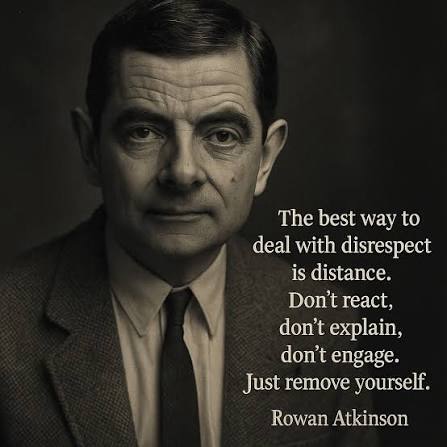
The best quote known for its uniqueness came from the world famous comedian who didn’t utter a single word to get the audience closer to his powerful expressions.
Rowan Atkinson (Mr.Bean) once said:
“Distance is the only answer to disrespect. Don’t react. Don’t argue. Don’t get involved in drama. Simply remove your presence.”
Interestingly World Health Organization used Mr Bean’s message for physical distancing. The character has been featured in animations promoting social distancing and kindness during the COVID-19 pandemic.
Action items are more or less similar irrespective of the type of distancing whether it is Physical Distancing or Psychological Distancing.
A research article published in Encyclopedia of Quality of Life and Well-Being Research describes three dimensions of psychological distance: spatial, social, and hypothetical.
Three Dimensions of Psychological Distance
- The spatial distance is that from the individual to the target of his judgment.
- The social distance is between the person and the rest of the world.
- The hypothetical distance is between certain and hypothetical events
Psychological distancing is a technique to gain perspective and regulate emotions by mentally stepping back from a situation or oneself.
Literature survey cites the benefits of psychological distancing
- Emotional regulation: Reduces the intensity of negative emotions like anger, hurt, and anxiety.
- Improved problem-solving: Enables clearer thinking by removing the emotional “noise” from a situation.
- Enhanced resilience: Helps individuals cope with stress and negative experiences more effectively.
- Better performance: Can improve performance in stressful situations, such as public speaking or taking a test.
Concluding Remarks:
All distancing intentions can’t be weighed equally. It depends on the purpose for good or bad isolation. Distancing outputs depend on how effective the intentions are brought for yielding the ethical and socially acceptable solutions.
 முப்பரிமாணம் (Mupparimanam) - 3D development for connecting the ancient and modern thinking with UN SDGs Sustainable Development Goals. 3D thinking on Tamil Literature and Traditional Practices, the source of Global Goals.
Leave a comment