
STEM Education
STEM education is a value added learning component for the worldwide school students. Access to STEM intensive learning resources is not equally distributed in the global stage. Developed economies compete in developing the STEM learning at the school level to get the budding talents onboard the integrated scientific research and innovation ecosystem. The growth of STEM education in the country level science ecosystem is purely dependant on the opportunities available to the school students.

Ranking through CEE Index
Center for Excellence in Education (CEE) releases Index of Excellence in STEM Education. This index analyzes individual student rankings in each of five STEM-related Olympiad competitions, generates averages and rankings by participating country, and compares overall Olympiad performance by country.
The average rankings of students in each country are calculated and ranked for each Olympiad, with the average of those rankings determining the final country rank on the CEE Index based on the combined outcomes of International Olympiads in Biology, Chemistry, Physics, Math, and Informatics.
India stands at 8th position in CEE 2025 Index of Excellence in STEM Education. The People’s Republic of China has ranked either first or second in the CEE Index every year since 1988. The USA claimed a second-place overall ranking in the CEE Index, with first place showing in Physics, second place in Mathematics, third place in Biology and Chemistry and a 12th in Informatics.

Indian Schools
According to recent UDISE+ data, India is housing approximately 14.72 lakh schools for 2024-2025 academic year with the majority being located in rural areas.
Access to science education resources is not equal for 14.72 lakh schools. This situation equally applies for the Indian school students in the overseas, especially from the geographies not known for science and technology development. Indian Diaspora students living in the developed economies with the intense focus on S&T development have the great opportunities in learning the STEM education and laying a strong foundation for enhancing their science learning while they progress to the world class higher education.
Indian Schools in the Gulf Countries
Ministry of External Affairs, Government of India reported that there are a large number of Indian schools operating in Gulf countries which cater to the needs of Indian expatriate population based in the region.
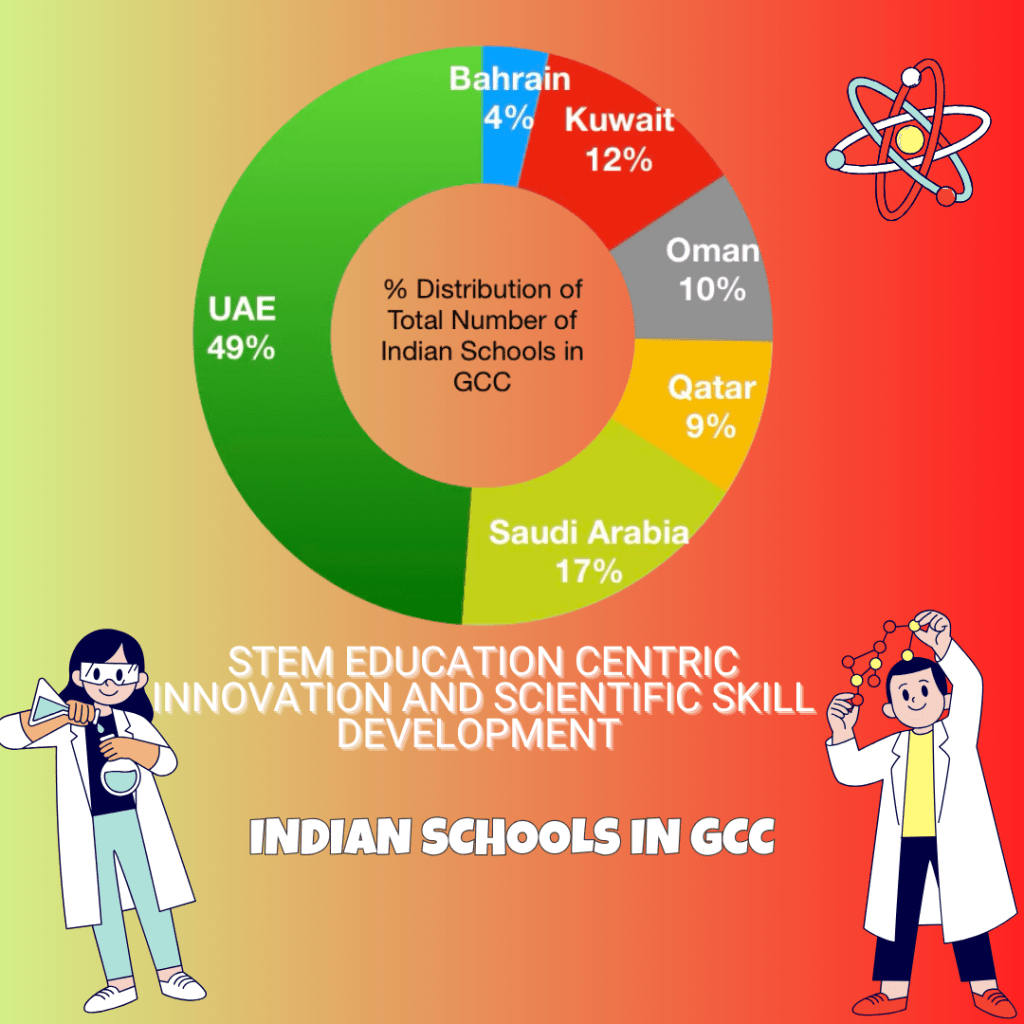
Source: RAJYA SABHA UNSTARRED QUESTION NO-1663 ANSWERED ON- 03/08/2023
INDIAN SCHOOLS IN GULF COUNTRIES
According to the Indian Embassy, there are 26 Indian schools in Kuwait which are affiliated to Central Board of Secondary Education (CBSE) Delhi. These schools are providing CBSE patterned education to more than 60,000 students. Indian Embassy in Dubai stated that Northern Emirates of the UAE have 81 schools following Indian Curriculum. 76 schools follow CBSE Curriculum, 4 schools follow ICSE and 6 schools follow Kerala State Board curriculum. Three out of the six schools offering Kerala Board Curriculum also offer CBSE Curriculum.
India Goes Global with Atal Tinkering Labs, an initiative of Atal Innovation Mission (AIM)
Atal Innovation Mission has recently launched several initiatives in the Gulf countries. Salient features of this program are:
- Taking forward Hon’ble PM Shri Narendra Modi’s vision of Viksit Bharat @2047, ATLs are scripting a global story of innovation & collaboration. 🇮🇳🌍
- In a historic first, Hon’ble Education Minister Shri Dharmendra Pradhan launched Atal Tinkering Labs in 12 schools across all 7 Emirates of UAE 🇮🇳🤝🇦🇪
- These ATLs will nurture curiosity, creativity & problem-solving through hands-on learning, turning students into future-ready innovators.
- What began as a vision to ignite innovation in India’s classrooms is now inspiring young minds worldwide — empowering the youth of India & UAE to become next-gen entrepreneurs & changemakers! 🚀💡
Interesting expansion to get the Indian students onboard ATLs and make them collaborating with native side. Much needed for CBSE Schools in the Middle East. Access to innovation ecosystem is very limited for Indian students taking CBSE curriculum in GCC region.
Indian school students have to depend on the school resources for enhancing their scientific knowledge. At the present time the opportunities are very limited for these aspirants outside the school level programs. There is a great need for the Professional and Cultural Associations housing Indian Community to come forward in bringing the adequate resources to the students through various channels.
Science India Forum
United Arab Emirates introduces India’s rich scientific heritage to the youth in order to kindle scientific temperament within them. SIF UAE like its parent organization VIBHA (Vijnana Bharati), believes in promoting and popularizing Indian sciences for the service of society. Active in UAE for the past 16 (since 2006) years.
Shaastrotsav (Festival of Science) is a prominent science and technology event held in Kuwait, organized by the Kuwait Chapter of the NSS College of Engineering Alumni Association (NSSCEAA Kuwait). The event, which began in 2009, is highly popular among students and professionals in Kuwait and features various competitions and exhibitions.
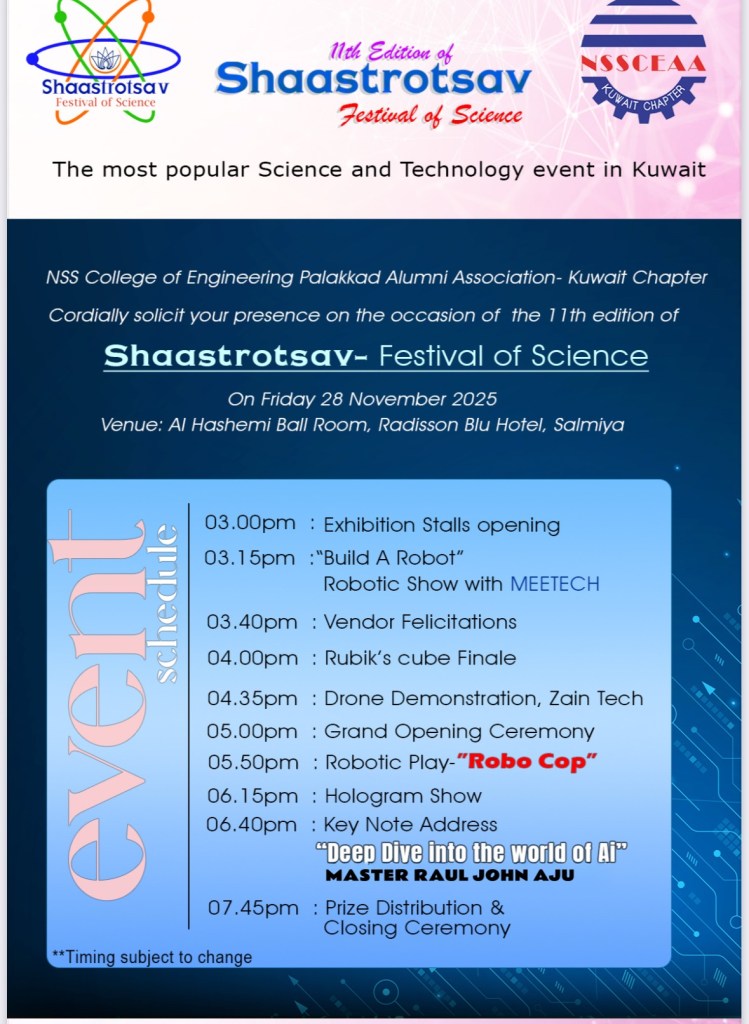
Indian Embassies in GCC region have to open doors for collaboration of India based scientific organizations with the Indian students in the Middle East.
 முப்பரிமாணம் (Mupparimanam) - 3D development for connecting the ancient and modern thinking with UN SDGs Sustainable Development Goals. 3D thinking on Tamil Literature and Traditional Practices, the source of Global Goals.
Leave a comment