How are the happiest countries performing in the income level, global knowledge index and sustainable development goals rankings?
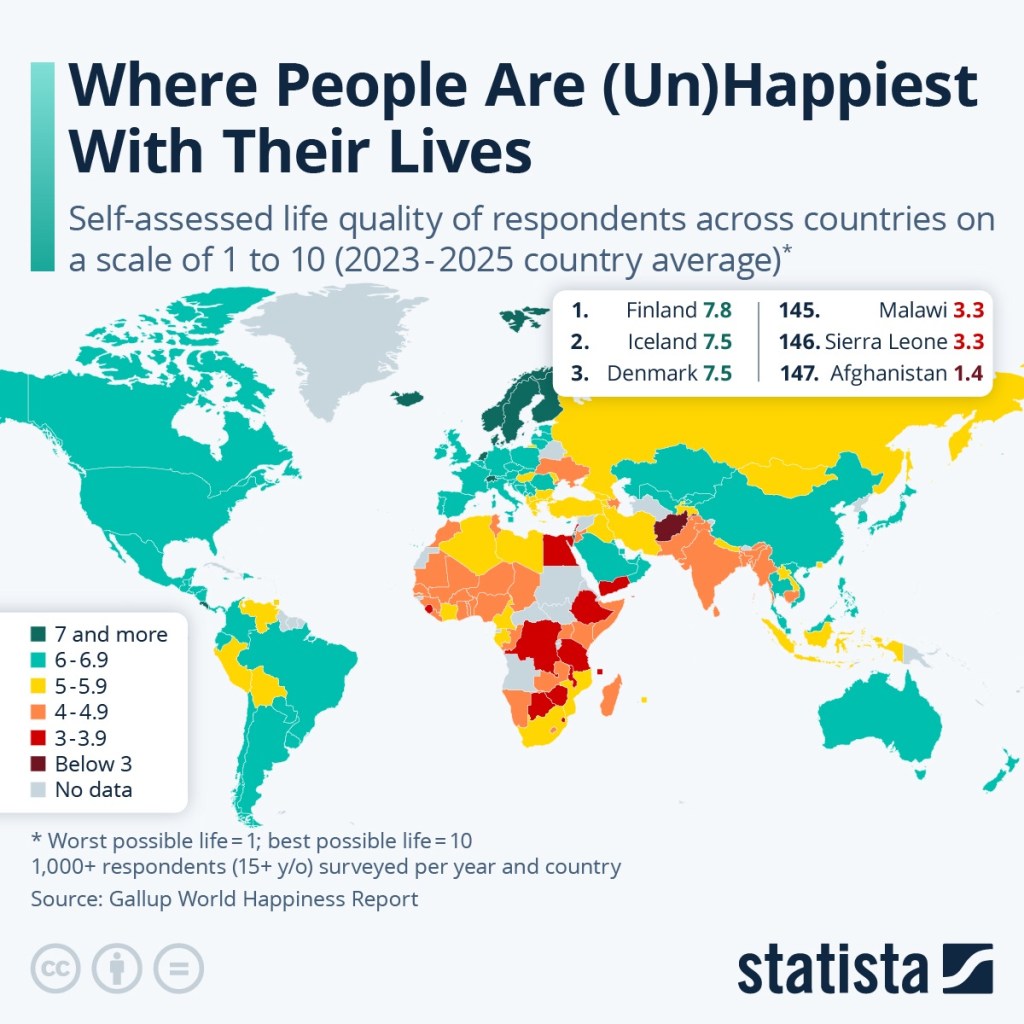
Nordic countries lead the world happiness rankings once again. Finland is still in a group of one at the top, followed by a group of three: Iceland, Denmark, and Costa Rica. Sweden and Norway complete the top six, followed by the Netherlands, Israel, Luxembourg, and Switzerland to round out the top ten. India stands at 116th rank out of 147 countries analysed in this report. China’s position is 65.
World Happiness and Social Media Use
According to World Happiness Report 2026, young people in North America and Western Europe are much less happy than 15 years ago. Over the same period, social media use has greatly increased. Social media use in the Middle East and North Africa is among the highest in the world. Life satisfaction is highest at low rates of social media use and lower at higher rates of use, according to data from the Programme for International Student Assessment (PISA) covering seven internet activities for 15-year-old students in 47 countries. The world happiness report interpreted that heavy users of social media are at risk, especially in English-speaking countries and Western Europe.
This report depicted that the estimated relationship between internet use and wellbeing varies sharply across generations, genders, and regions. It is strongly negative for Gen Z, moderately negative for Millennials, near zero for Gen X, and slightly positive for Baby Boomers. The generational gradient reflects both greater increases in internet use among younger cohorts (exposure) and more negative estimated coefficients for those same cohorts (susceptibility).
World Happiness goes hand in hand with Income Level, Global Knowledge Index and SDG Rankings
While several factors are taken into consideration for arriving at the performance of 147 countries, it is equally important to put a correlation for world happiness with the performance of countries in other pertinent evaluations, especially Income Status, Global Knowledge Index Ranking and Sustainable Development Goals Ranking for the corresponding period. This article attempts in bringing such correlation to describe the outcome of happiness through income level, knowledge power and sustainable development goals.
The Global Knowledge Index 2025 measures and compares the knowledge performance of 195 countries across six dimensions — from education and research to ICT, economy, and governance — offering evidence-based insights to guide policy and action.
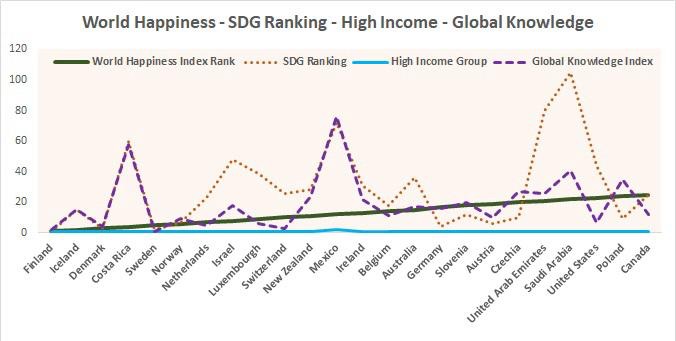
Top 25 countries in Global Happiness Index belong to High Income Group except Mexico at GHI rank of 12 in the pool of Upper-middle income countries.
Countries performing better in both World Happiness and Global Knowledge Index are: Finland, Denmark, Sweden, Norway, Luxembourgh, Switzerland, Belgium, Australia, Germany, Slovenia, Austria, Czechia, United States and Canada.
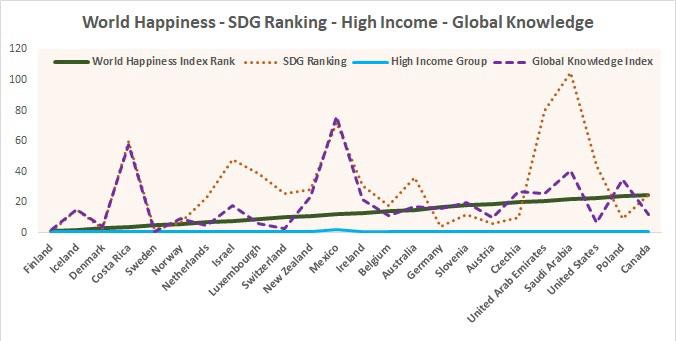
Countries which exhibit better performance in both World Happiness and SDG Ranking are: Finland, Denmark, Sweden, Norway, Belgium, Germany, Slovenia, Austria, Czechia, Poland and Canada.
Happiness without Sustainable Development
Performance of UAE and Saudi Arabia in the pool of current Top 25 World Happiness Countries should be of concern in the next year ranking due to the present geopolitical conflicts and war tensions. These countries come with the rank of 80 and 105 in SDG Ranking, not a good combination of happiness and sustainable development. There is a great need for Happiness to go hand in hand with Knowledge Power and Sustainable Development for interfacing Human Development with Planet’s Sustainable Development.
Knowledge power is very much required to meet the objectives of happiness through resolving the perennial challenges and accelerating efforts for promoting the social, ecological and economic growth. Resource utilisation and replinishment are pertinent drivers within the framework of present day happiness to sustain the resource efficiency for future consumption.
The second Top-25 hosts a few countries that are tagged as lower-middle and upper-middle income group countries. Vietnam stands at 45th rank of world happiness but comes as lower-middle income country. Detailed analysis will be presented in the next article.
Conclusions
Common pattern observed for the Top-25 World happiest countries is the income level. These countries belong to the high income group. Knowledge is also required to keep these countries in the track of happiness. 14 countries in Top-25 of happiness perform well in the global knowledge index ranking. When it comes to the combination of happiness and sustainable development, the collective performance number reduces to 11 out of 25.
 முப்பரிமாணம் (Mupparimanam) - 3D development for connecting the ancient, conventional and modern thinking with Global challenges and UN SDGs Sustainable Development Goals
Leave a comment